

Friends of the Riney Canine Health Center,
Thank you for joining our pack! I’m Brian Collins, an extension associate for the Cornell Richard P. Riney Canine Health Center, and I’m pleased to share this month’s “From the Vet’s Desk” monthly health tip with our members.
August is already one of my favorite months and even more so when in 2020 it was designated as National Dog Month to recognize the importance of dogs in our lives. Prior to that in 2004, August 26th was named as National Dog Day in recognition of the founder’s first shelter dog adoption, with the purpose of highlighting shelter dogs, service dogs and dogs that work in law enforcement and the military. Although my dogs insist on celebrating year-round (please don’t tell my cats), I’ve been making an extra effort to squeeze in extra walks, swimming trips and healthy treats.
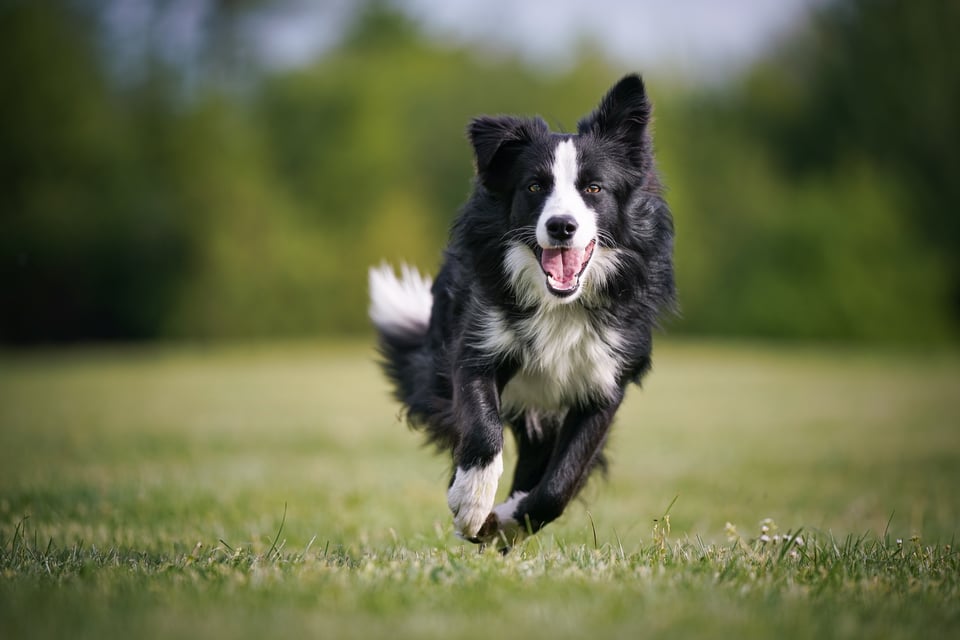
Last weekend, a new opportunity caught my attention. I heard about an AKC Fast CAT event in my area (CAT stands for Coursing Ability Test). I’ve long suspected that one of my dogs (a 9-year-old male Russell Terrier) would enjoy participating in agility and I decided last minute to check it out. Though Speck doesn’t have an AKC registration number (yet), we were able to enter as a “fun run.” Not knowing what to expect, we watched the other dogs for a couple of hours and walked around to get warmed up. One at a time, the dogs run a 100-yard dash on a fenced course on the grass. Electronic timers record their overall time for the event and their speed. What motivates them to run? At the starting line someone holds them by their leash. At the other end, the dog’s owner stands to greet and encourage them. In between is a lure (a white plastic bag) attached to a mechanical pulley system. When the timer starts, the holder releases the dog as the white bag is pulled toward the finish line. At the far end is the dog’s person calling and motioning to their dog to run towards them. To my untrained eye, it appeared that some dogs were following the lure while some were running to their person (what we would consider “recall”), and for some, a combination of both. Dogs who are officially entered receive points based on their speed that includes a size handicap based on their height, which is measured at the shoulder.
It was fascinating to watch dogs of different sizes, breeds, ages and personalities as they each took their turn. One nervous Cavalier King Charles Spaniel couldn’t bring herself to run the course but instead turned and ran the opposite direction, slipping through the fence and running to a group of strangers. I’m hoping her confidence improves with more practice! Then it was Speck’s turn. I left him with a volunteer who would release him at the appropriate time, while I walked to the other end (with another leash) where I would meet him. Though we have practiced recall many times, 100 yards suddenly seemed really far away. When the timer started, I couldn’t tell if he knew where I was, but I began calling his name, jumping up and down, and waving a fist full of treats. Suddenly, it clicked and he started running toward me, trying to figure out what that white plastic bag was all about, and intrigued by the smells of the previous dogs. His speed and focus increased as he finally reached me with great excitement. Feeling inspired by his first personal victory, we signed up for a second run. He definitely understood the assignment better the second time around, with an observer noting that he seemed to be following the lure more than the initial run.
I think we’re both hooked, and I’ll be looking for upcoming events (I must confess -- I want some ribbons, too.). It was a great opportunity to try something new; enrichment is so important for a dog’s mental and physical well-being. I love seeing people and their dogs interact, as well as experience the comradery of dog people when they get together (“Can you spare a poop bag?”). If I’ve inspired you, you can search the AKC website for this and other types of events.
When considering any kind of physical activity with your dog, it’s important to know if your dog has any health concerns that could negatively impact their experience, which could include conditions such as lameness or heart disease. Additionally, if your dog hasn’t been very physically active recently, it’s important to ease into increased movement over a few weeks, and to include some warm-up exercises before engaging in sudden bursts of activity. It’s also important to consider other factors in the summer including the air temperature, humidity, and dog-specific variables such as coat type and having a short snout. Offer cool water frequently and use a portable fan or move to an air-conditioned space if necessary.
As always, thank you for being a Riney Canine Health Center member. We look forward to catching up with you next month!
Dr. Brian Collins, D.V.M. ‘94
Extension Veterinarian
Cornell Richard P. Riney Canine Health Center
Visit our website today for more canine health topics and give your furry friend the care they deserve.
Questions: Discover expert tips, personalized advice and friendly support from our Big Red Bark Chat AI Assistant!